How Parlay Odds Work: Payouts, Probability and Pitfalls
How parlay odds work: calculate any parlay payout by hand, see the real chance of hitting, and learn how pushes and same game parlays change things.
Parlays are the most popular bet in sports betting for a simple reason: small stakes, big payouts. A few legs at normal odds can turn $10 into $100 or more. But few bettors know exactly how parlay odds are calculated, or how much harder they are to hit than they look.
This guide explains how parlay odds work, how to calculate a parlay payout by hand, what the real chances of hitting are and how pushes and same game parlays change things.
What is a parlay?
A parlay (called an accumulator or acca in the UK) combines two or more bets, called legs, into one. Every leg has to win for the parlay to pay. If one leg loses, the whole bet loses.
In exchange for that extra risk, the payout is much bigger than betting each leg on its own.
How parlay odds are calculated
The easiest way to work out a parlay is with decimal odds. Multiply the decimal odds of every leg together, and that's your parlay's decimal odds.
If you're used to American odds, convert first:
- Positive odds: divide by 100 and add 1. +150 becomes 2.50.
- Negative odds: divide 100 by the odds (without the minus sign) and add 1. -110 becomes 1.91.
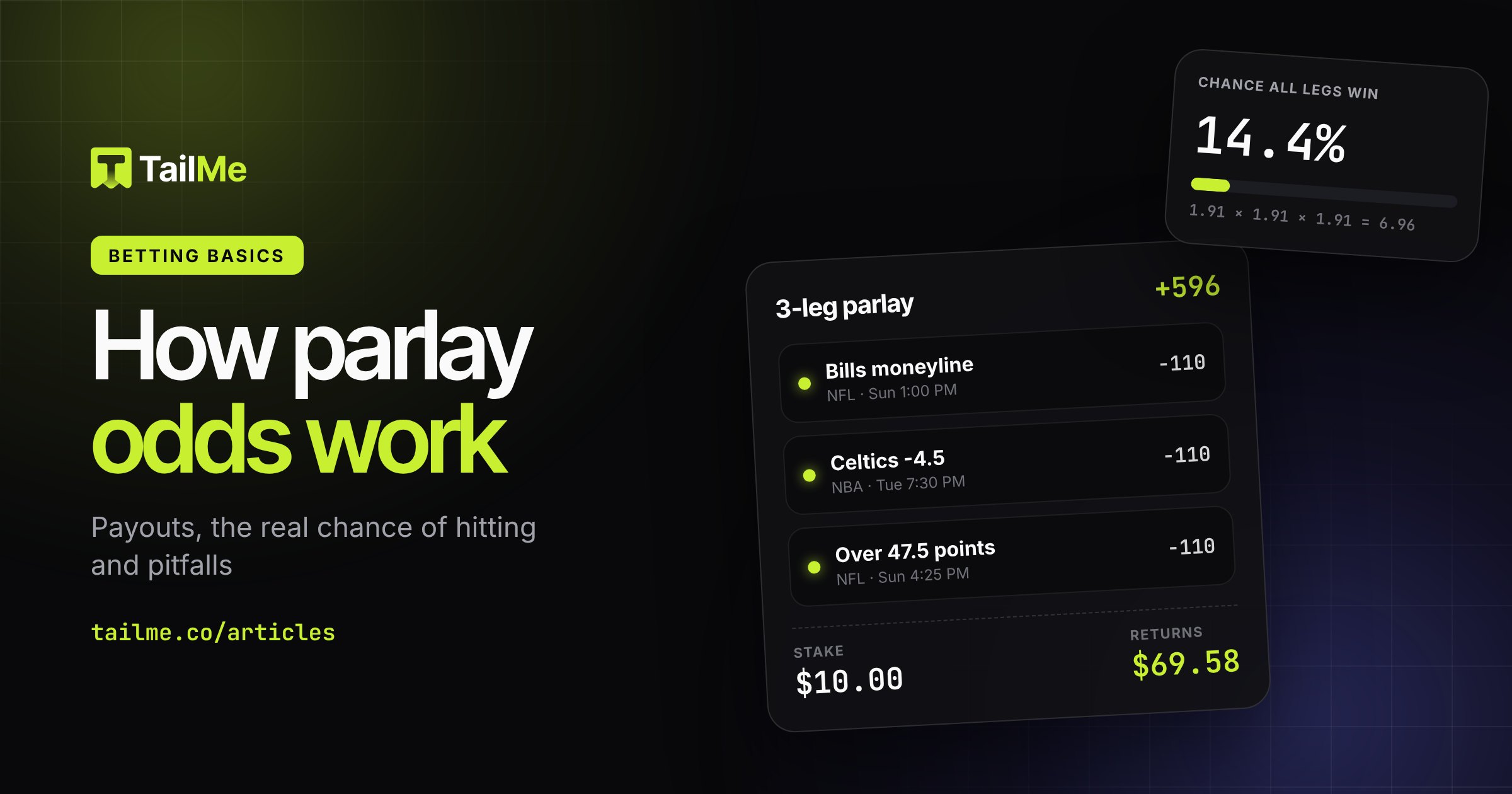
Example: a three-leg parlay at -110, -110 and -110.
- Each leg: 1.909
- Parlay odds: 1.909 × 1.909 × 1.909 = 6.96
- As American odds: about +596
A $10 stake returns $69.58 in total, a profit of $59.58.
Parlay payouts at a glance
Here's what standard -110 legs pay as you add more of them:
| Legs | Decimal odds | American odds | $10 returns |
|---|---|---|---|
| 2 | 3.64 | +264 | $36.45 |
| 3 | 6.96 | +596 | $69.58 |
| 4 | 13.28 | +1228 | $132.83 |
The payout roughly doubles with each extra leg. That's what makes parlays so tempting.
The real chance of hitting a parlay
The chance of a parlay winning is every leg's chance multiplied together.
At -110, each leg has an implied probability of 52.4%. That's the win chance the odds suggest, including the sportsbook's margin.
| Legs | Chance all legs win (implied) |
|---|---|
| 1 | 52.4% |
| 2 | 27.4% |
| 3 | 14.4% |
| 4 | 7.5% |
A four-leg parlay of near coin flips hits about 1 time in 13. Most of the time, at least one leg misses.
Why parlays favour the sportsbook
Every bet has a margin built in, known as the vig or juice. A standard -110 bet on a true 50/50 outcome has an expected loss of about 4.5% of your stake.
In a parlay, those margins multiply. If every leg is a true 50/50 at -110:
| Legs | Expected return on each $100 staked |
|---|---|
| 1 | −$4.55 |
| 2 | −$8.88 |
| 3 | −$13.03 |
| 4 | −$16.98 |
The more legs you add, the bigger the sportsbook's edge. That's why sportsbooks promote parlays so heavily.
This doesn't mean parlays are always a bad bet. If each leg has a genuine edge, combining them multiplies that edge too. But for most bettors, most of the time, parlays cost more than straight bets over the long run.
You can check any bet's edge with the expected value calculator, and strip the margin out of a market with the no-vig calculator.
What happens if a leg pushes or is voided?
At most sportsbooks, a leg that pushes (lands exactly on the spread or total) or is voided (for example, a player doesn't play) is removed. The parlay is then paid at the odds of the remaining legs.
So a three-leg parlay with one push becomes a two-leg parlay. A two-leg parlay with a push becomes a straight bet. Rules vary between sportsbooks, so check yours.
Same game parlays
A same game parlay (SGP) combines legs from one game, such as a team to win, a player to score and the total going over.
Because these outcomes are related, sportsbooks don't simply multiply the odds. If a team wins comfortably, their star player is more likely to have a big game, so the legs aren't independent. Sportsbooks price that in, and SGP odds are often lower than multiplying the legs would suggest. Many sportsbooks also build a larger margin into SGPs.
A parlay calculator shows the standard price of multiplying the legs. Your sportsbook's SGP price may differ.
Hedging a parlay
If your parlay is down to its final leg, you can hedge: bet on the opposite outcome to lock in a profit whichever way it goes. You give up some of the potential payout in exchange for a guaranteed result.
The hedge calculator shows exactly how much to bet on the other side to lock in an equal profit, or to get your stake back.
Tips for smarter parlays
- Keep them short. Two or three legs keep your chances realistic.
- Stake small. Treat parlays as a small part of your betting, not the main event.
- Know what each leg is worth. If you wouldn't bet a leg on its own, don't add it to a parlay.
- Shop for odds. Better odds on each leg compound across the parlay.
- Track them separately. Record parlays as single bets so you can see if they're helping or hurting your results. How to track your betting record explains how.
For cappers posting parlays
Parlays get attention on social media, and a big hit can bring in a lot of new followers. Show them honestly: post the parlay before the games, show the odds and stake, and grade it when it settles, especially when it misses.
TailMe shows parlays as clean bet slips on your page, with odds in each visitor's preferred format, so followers can see every leg at a glance.
The short version
Parlay odds are each leg's decimal odds multiplied together. The payouts grow fast, but so does the chance of missing, and so does the sportsbook's edge. Keep them short, stake small, and use a calculator to see exactly what you're getting.
Only bet what you can afford to lose. If betting stops being fun, free and confidential support is available.