How to Track Your Betting Record: Units, ROI and Win Rate
How to track your betting record: what to log, how units, ROI, win rate and break-even work, and how to show your record so followers trust it.
"I'm up big this month" means nothing without numbers. Whether you bet for yourself or post picks for followers, tracking your betting record properly is the only way to know if you're winning, and the only way to prove it to anyone else.
This guide explains how to track your bets, what units and ROI mean, how to work out your win rate and break-even point, and how to show your record so people trust it.
Why tracking matters
Memory is a terrible bookkeeper. People remember the big parlay that hit and forget the ten small losses before it. A written record fixes that.
A proper record tells you:
- whether you're actually profitable
- which sports, markets and bet types make or lose you money
- whether your stake sizes make sense
- how you're doing over a meaningful number of bets, not one weekend
For cappers, it's also your proof. Followers and paying members judge you on your record more than anything else.
What to record for every bet
Keep it simple and consistent. For each bet, note:
- Date of the bet
- Sport and league
- Game or event
- Market, such as spread, total, moneyline or a player prop
- Odds you got
- Stake in units
- Result: win, loss, push or void
- Profit or loss in units
A spreadsheet works. So does a betting tracker app. What matters is recording every bet, including the ones you'd rather forget.
Units: the language of betting records
A unit is your standard stake. Many bettors set one unit at 1% to 2% of their bankroll. With a $1,000 bankroll and 1% units, one unit is $10.
Reporting in units instead of money does two things:
- It keeps your record meaningful whatever your bankroll. +10 units is +10 units whether someone bets $5 or $500 a unit.
- It stops your record from being inflated by one oversized bet.
Most picks should be 1 unit. If you sometimes bet more on stronger plays, keep it within a small range, such as 0.5 to 2 units, and stick to it.
How to calculate profit in units
For a win, profit is your stake times the decimal odds minus one. For a loss, you lose your stake. Pushes and voids return your stake, so they're zero.
At -110 (1.91 in decimal), a 1-unit win pays about 0.91 units. A 1-unit loss costs 1 unit. That's why winning just over half your bets at -110 is not enough to profit, as you'll see below.
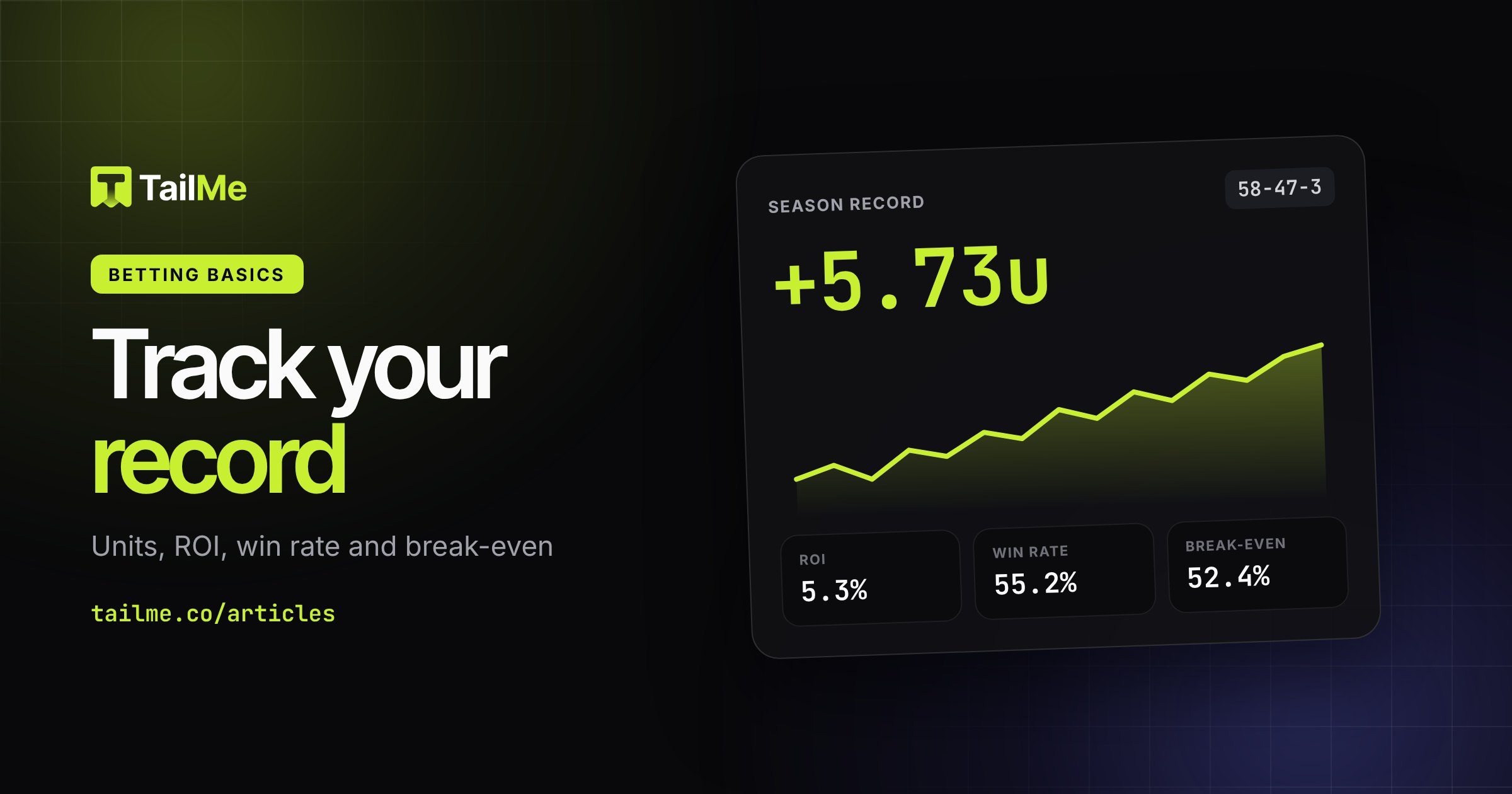
Example: a record of 58 wins, 47 losses and 3 pushes, all 1-unit bets at -110:
- Wins: 58 × 0.909 = +52.73 units
- Losses: 47 × 1 = −47 units
- Profit: +5.73 units
ROI: the number that matters most
Return on investment (ROI) is your profit divided by the total amount you've staked.
In the example above, the total staked is 108 units (58 + 47 + 3), so the ROI is 5.73 ÷ 108 = 5.3%.
ROI matters because it compares records fairly. Someone who made +20 units from 2,000 bets has a 1% ROI. Someone who made +20 units from 200 bets has a 10% ROI. Same units, very different performance.
Over hundreds of bets, a sustained ROI of a few percent at standard odds is genuinely good. Very high ROIs over small samples are usually luck, good or bad.
Win rate and break-even
Your win rate is wins divided by bets that were settled as a win or a loss (pushes and voids aren't counted). In the example, that's 58 ÷ 105 = 55.2%.
On its own, win rate means little. What matters is how it compares with your break-even win rate, which depends on the odds:
| Odds | Decimal | Break-even win rate |
|---|---|---|
| +150 | 2.50 | 40.0% |
| +100 | 2.00 | 50.0% |
| -110 | 1.91 | 52.4% |
| -120 | 1.83 | 54.5% |
At -110 you need to win 52.4% of your bets just to break even. A 55.2% win rate at -110 is profitable. A 55% win rate at -150 is not. Underdog bettors can win well under half their bets and still profit.
Use the odds converter to find the break-even rate (implied probability) for any price.
Track by sport and market
Once you have a few hundred bets, split your record by sport, league and market. Most bettors find they're profitable in one or two areas and losing in others. Cutting the losing areas is often the quickest way to improve your results.
Useful splits include:
- sport and league
- bet type: spreads, totals, moneylines, props, parlays
- favourites vs underdogs
- stake size
Monthly recaps
Results swing from week to week. Monthly totals smooth that out and show the trend. For each month, track:
- wins, losses and pushes
- units staked
- profit in units
- ROI
A run of monthly recaps, including the losing months, is far more convincing than an all-time number on its own.
How to show your record so people trust it
If you post picks publicly, how you show your record matters as much as the numbers.
- Post picks before the game. Timestamps prove you didn't pick after the fact.
- Grade everything. Losses, pushes and voids included.
- Show units and ROI, not just a win-loss count.
- Show recent form and monthly history, not just a lifetime total.
- Say it's self-reported. Honesty about what your record is builds more trust than pretending it's audited.
On TailMe, the record block does the maths for you: monthly results, units, ROI, a running profit chart and your last ten results, labelled as self-reported. You can import past results from a CSV, and if you're on a tipping team, the same record shows on your team page. See track record for more.
Common tracking mistakes
- Skipping bets. A record with gaps is just a highlight reel.
- Changing stake sizes to chase losses. It distorts your units and usually makes losses worse.
- Counting parlays as several bets. A parlay is one bet with one stake.
- Judging too early. 50 bets tell you very little. Several hundred start to mean something.
- Ignoring the vig. Winning 52% at -110 is a losing record, even though it sounds good.
Start today
Pick a format, record every bet from today and total it up monthly. Within a season you'll know far more about your betting than any gut feeling can tell you, and you'll have a record you can stand behind.
Only bet what you can afford to lose. If betting stops being fun, free and confidential support is available.