What Is Closing Line Value (CLV) in Sports Betting?
What closing line value (CLV) is, how to calculate it and why beating the closing line is one of the best signs of a real betting edge.
Winning bets feels like the best sign that you're good at betting. It isn't. Over a few hundred bets, luck can make a poor bettor look great and a great bettor look poor.
Professional bettors look at something else first: closing line value, or CLV. This guide explains what closing line value is, how to calculate it and why it's one of the best signs that a bettor, or a capper, actually has an edge.
What is the closing line?
The closing line is the final odds on a bet just before the game starts and betting closes.
Odds move between when a market opens and when it closes. Sportsbooks adjust prices as money comes in, injury news breaks, lineups are confirmed and sharp bettors place big bets. By kickoff, the line has absorbed nearly all the information available.
That's why the closing line is widely seen as the most accurate price in a market. It's not perfect, but it's very hard to beat consistently.
What is closing line value?
Closing line value measures whether you got a better price than the closing line.
- Positive CLV: you bet at better odds than the line closed at.
- Negative CLV: you bet at worse odds than the line closed at.
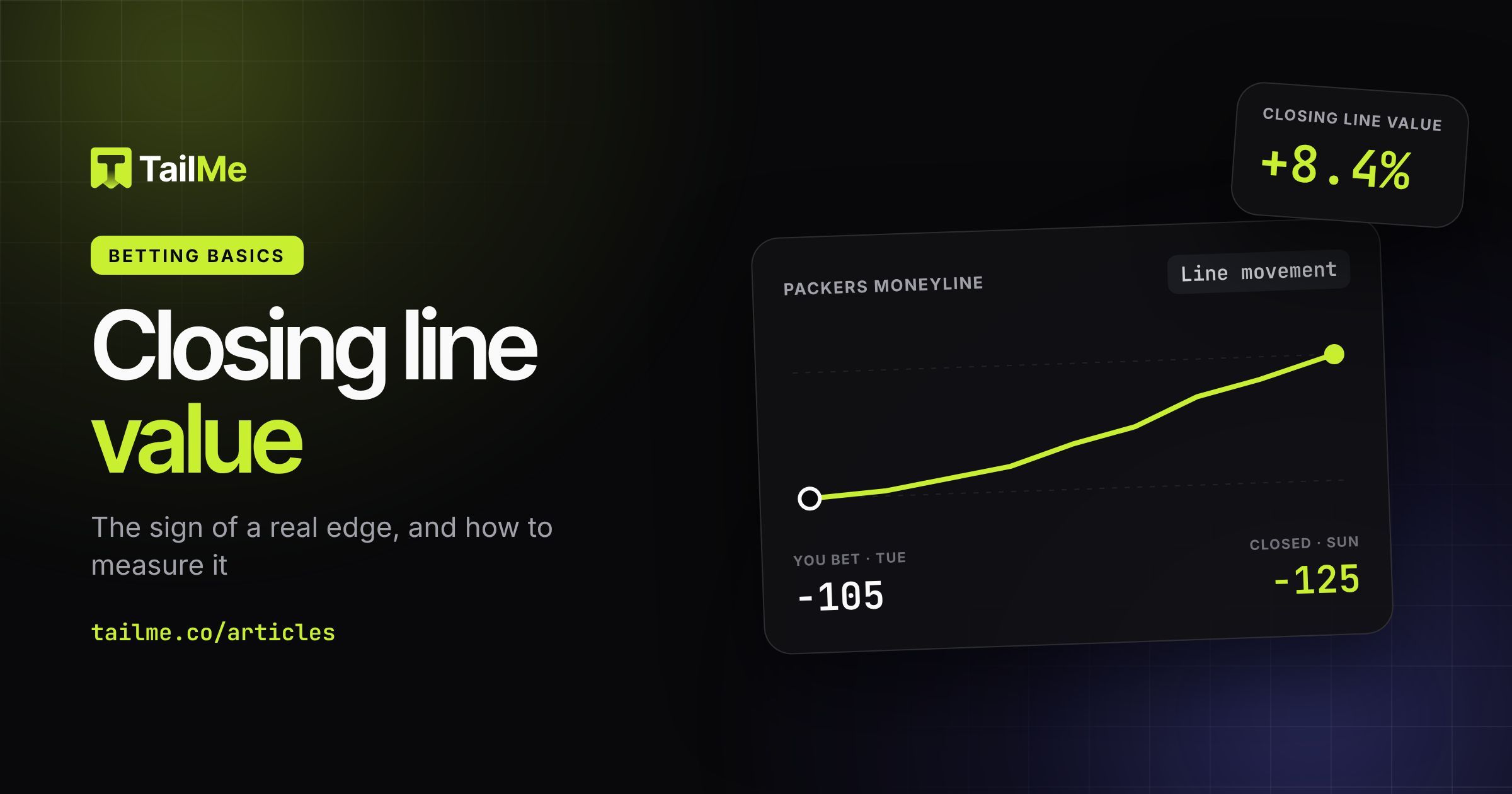
Example: you bet the Packers at -105 on Tuesday. By Sunday, after news and sharp money, they close at -125.
You got the Packers at a better price than the market's final, best-informed view. That's positive CLV, whether the Packers win or lose.
How to calculate CLV
The simplest way is to compare decimal odds. If you're not sure how those work, how to read betting odds explains every format.
CLV = (your decimal odds ÷ closing decimal odds) − 1
Using the example above:
- You bet at -105, which is 1.952 in decimal.
- It closed at -125, which is 1.800 in decimal.
- CLV = 1.952 ÷ 1.800 − 1 = +8.4%
You can also compare implied probabilities. At -105 the implied probability was 51.2%. At -125 it was 55.6%. The market ended up rating the Packers' chances much higher than the price you paid suggested.
For a more precise number, remove the vig from the closing line first, using both sides of the market, and compare your odds against the fair price. The no-vig calculator does that for you.
Why CLV matters more than short-term results
Over 100 bets, a bettor with no edge can easily be up 10 units or down 10 units through luck alone. You'd need many hundreds or thousands of bets before results alone prove much.
CLV gives you a signal much sooner. If a bettor consistently gets better odds than the closing line, they're consistently getting the price right before the market does. Over time, that tends to show up in their results.
That's why:
- Professional bettors track CLV on every bet.
- Sportsbooks watch for it. Bettors who consistently beat the closing line are often the ones whose limits get cut.
- Results and CLV together are far more convincing than results alone.
A bettor who is up 20 units with negative CLV may simply be on a lucky run. A bettor who is slightly down but beats the closing line consistently may be unlucky, and likely to recover.
What causes line movement?
Understanding why lines move helps you get CLV more often:
- Injury and lineup news. A star ruled out can move a line by several points.
- Sharp money. Big bets from respected bettors cause sportsbooks to adjust quickly.
- Public money. Heavy betting on popular teams can push lines, especially close to game time.
- Weather. Wind and rain move totals in football and baseball.
- Market corrections. Early lines are set with less information and less money behind them.
How to get more CLV
- Bet early when you have an opinion. Opening lines are the softest. If your read is right, the market will move toward you.
- Shop for the best price. Getting -105 instead of -110 at another sportsbook is instant value.
- Specialise. Smaller markets, like lower leagues, player props and niche sports, are priced less precisely, so there's more room to beat the close.
- Act on news fast. Lines take time to adjust after breaking news.
The limits of CLV
CLV is a strong signal, not a guarantee.
- Some markets are thin. In low-limit markets like obscure player props, the closing line can be less accurate, so CLV is less meaningful.
- It doesn't apply neatly to everything. Futures and live bets are harder to measure.
- You still need results. CLV predicts long-term profit. It doesn't pay out on its own.
Think of CLV and results as two halves of the picture. Strong CLV with a winning record is the best evidence a bettor has a real edge.
What CLV means for cappers and followers
For followers, CLV is a useful way to look past a hot streak. Ask whether a capper posts picks early enough, at odds you can still get, and whether those odds tend to move in their favour.
Timing matters too. A pick posted at -105 that closes at -125 is only valuable to followers who could bet it at -105. That's why cappers who post early, with the odds and time clearly shown, are more useful to follow.
For cappers, posting each pick with the odds at the time you shared it, then grading every result, is how you build a record people trust. Our guide on how to track your betting record covers the basics.
TailMe shows every pick with its odds and game time on a clean bet slip, and adds your graded results to your record.
The short version
The closing line is the final price before a game starts, and the most accurate price in the market. Closing line value measures whether you beat it. Results take thousands of bets to prove much, but consistently beating the closing line is one of the earliest and most reliable signs of a real betting edge.
Only bet what you can afford to lose. If betting stops being fun, free and confidential support is available.