How to Read Betting Odds: American, Decimal and Fractional
How to read betting odds in American, decimal and fractional formats, convert between them and turn any odds into an implied probability.
-110, +150, 2.50, 5/2. Betting odds come in three formats, and depending on where you live, your sportsbook might show any of them. They all describe the same two things: how much you'll win and how likely the sportsbook thinks the outcome is.
This guide explains how to read American, decimal and fractional odds, how to convert between them and how to turn any odds into an implied probability.
The three odds formats
| Format | Where it's used | Example |
|---|---|---|
| American (moneyline) | United States | +150 / -110 |
| Decimal | Europe, Canada, Australia | 2.50 / 1.91 |
| Fractional | UK and Ireland | 3/2 / 10/11 |
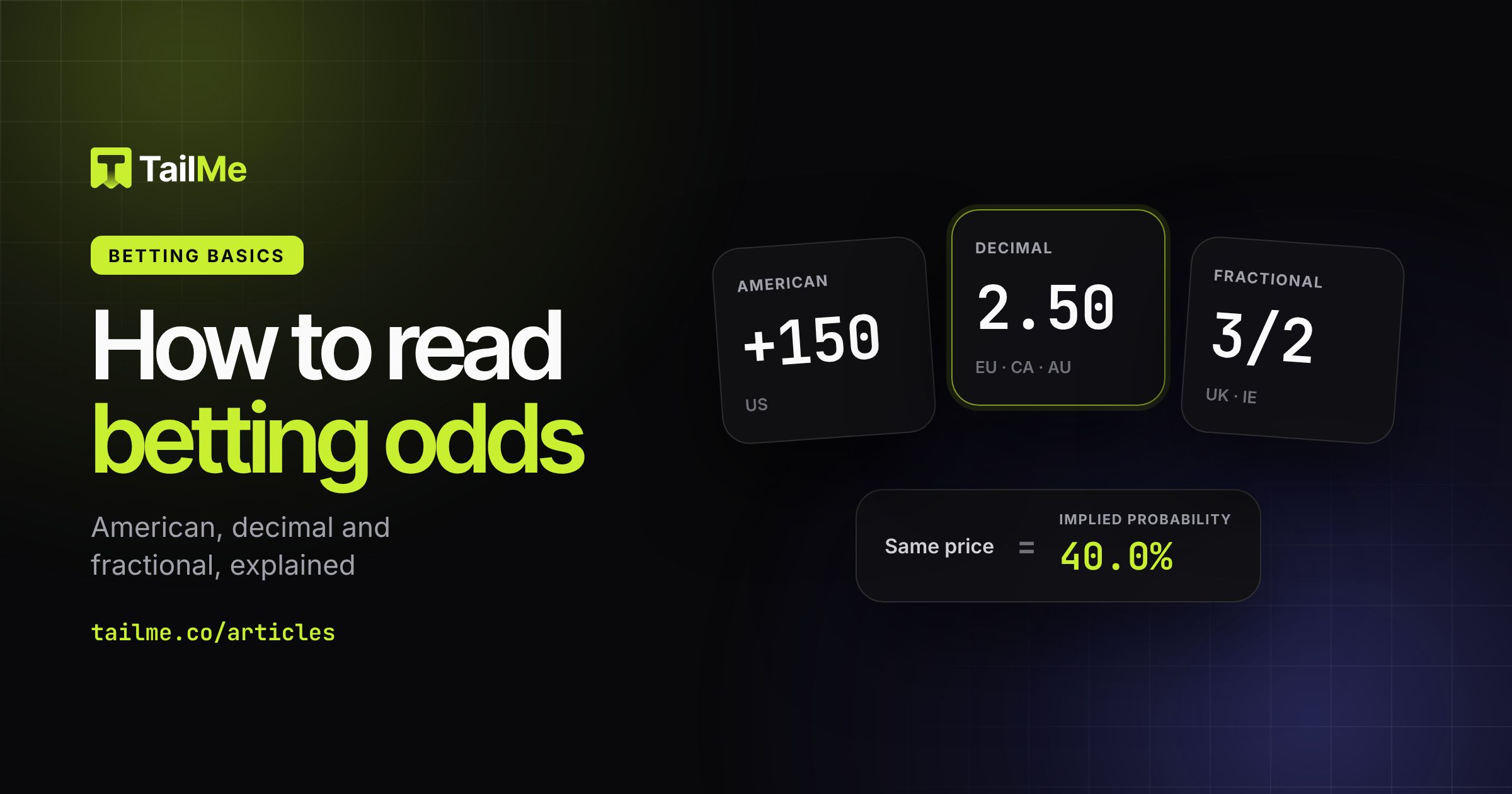
The odds in each column of that table are the same prices written differently. +150, 2.50 and 3/2 all pay the same.
How to read American odds
American odds use a plus or minus sign, based around a $100 bet.
Positive odds (+) show how much profit you'd make on a $100 bet. At +150, a $100 bet wins $150 profit, so you get $250 back in total. Positive odds mean the outcome is the underdog.
Negative odds (-) show how much you need to bet to make $100 profit. At -110, you bet $110 to win $100, getting $210 back in total. Negative odds mean the outcome is the favourite.
You don't have to bet $100. The odds scale to any stake:
- $20 at +150 wins $30.
- $20 at -110 wins $18.18.
- $20 at -200 wins $10.
+100 is an even-money bet: you win the same amount you stake.
How to read decimal odds
Decimal odds show your total return for each 1 unit staked, including your stake.
At 2.50, a $10 bet returns $25: $15 profit plus your $10 back. At 1.91, a $10 bet returns $19.10.
To find your profit, subtract 1 and multiply by your stake. Decimal odds of 2.00 are even money. Anything below 2.00 is a favourite, anything above is an underdog.
Decimal odds are the easiest to compare and calculate with, which is why parlay maths is done in decimals. How parlay odds work shows why.
How to read fractional odds
Fractional odds show your profit relative to your stake: profit / stake.
At 5/2 (said "five to two"), you win $5 for every $2 you bet. A $10 bet wins $25 profit and returns $35.
At 10/11, you win $10 for every $11 staked, the same as -110 in American odds.
When the first number is bigger, it's an underdog. When it's smaller, like 1/2, it's a favourite. Evens (1/1) is even money.
Converting between formats
| American | Decimal | Fractional |
|---|---|---|
| -300 | 1.33 | 1/3 |
| -200 | 1.50 | 1/2 |
| -110 | 1.91 | 10/11 |
| +100 | 2.00 | 1/1 (evens) |
| +150 | 2.50 | 3/2 |
| +200 | 3.00 | 2/1 |
| +300 | 4.00 | 3/1 |
| +500 | 6.00 | 5/1 |
The formulas:
- American to decimal (positive): (odds ÷ 100) + 1. +150 = 2.50.
- American to decimal (negative): (100 ÷ odds without the minus) + 1. -110 = 1.91.
- Decimal to American: if 2.00 or more, (decimal − 1) × 100. If under 2.00, −100 ÷ (decimal − 1).
- Fractional to decimal: (first number ÷ second number) + 1. 5/2 = 3.50.
Or skip the maths and use a converter:
What odds tell you about probability
Odds also tell you how likely the sportsbook thinks an outcome is. This is the implied probability.
The easiest formula uses decimal odds: implied probability = 1 ÷ decimal odds.
| Odds | Implied probability |
|---|---|
| -200 (1.50) | 66.7% |
| -110 (1.91) | 52.4% |
| +100 (2.00) | 50.0% |
| +150 (2.50) | 40.0% |
| +300 (4.00) | 25.0% |
If you think a team has a better chance of winning than its implied probability, the bet may have value. If you think its chance is lower, it doesn't.
Why both sides add up to more than 100%
Look at a typical game with both teams at -110. Each side's implied probability is 52.4%, which adds up to 104.8%. That extra 4.8% is the sportsbook's margin, called the vig or juice.
To see the "fair" odds without the margin, you remove the vig from both sides. That tells you what the sportsbook really thinks each outcome's chance is.
The no-vig calculator does this for any market, and the expected value calculator tells you whether a bet is worth taking at the odds you're given.
Shopping for the best odds
Different sportsbooks offer different odds on the same game. Getting -105 instead of -110 sounds small, but it adds up.
At -110, you need to win 52.4% of bets to break even. At -105, you need 51.2%. Over hundreds of bets, that difference can turn a losing record into a winning one. Serious bettors keep accounts at several sportsbooks for exactly this reason.
For cappers posting picks
Your followers don't all use the same format. A follower in New York reads -110. One in London reads 10/11. One in Toronto reads 1.91.
TailMe shows your picks in each visitor's preferred odds format automatically, so everyone reads your bet slips without converting anything.
The short version
American odds show profit on $100 (+) or the stake needed to win $100 (−). Decimal odds show your total return per unit staked. Fractional odds show profit relative to stake. All three describe the same price, and 1 ÷ decimal odds gives you the implied probability.
Only bet what you can afford to lose. If betting stops being fun, free and confidential support is available.