What Is a Unit in Sports Betting? Unit Size Explained
What is a unit in sports betting? How to choose your unit size, why cappers report results in units and how to work out units won. With examples.
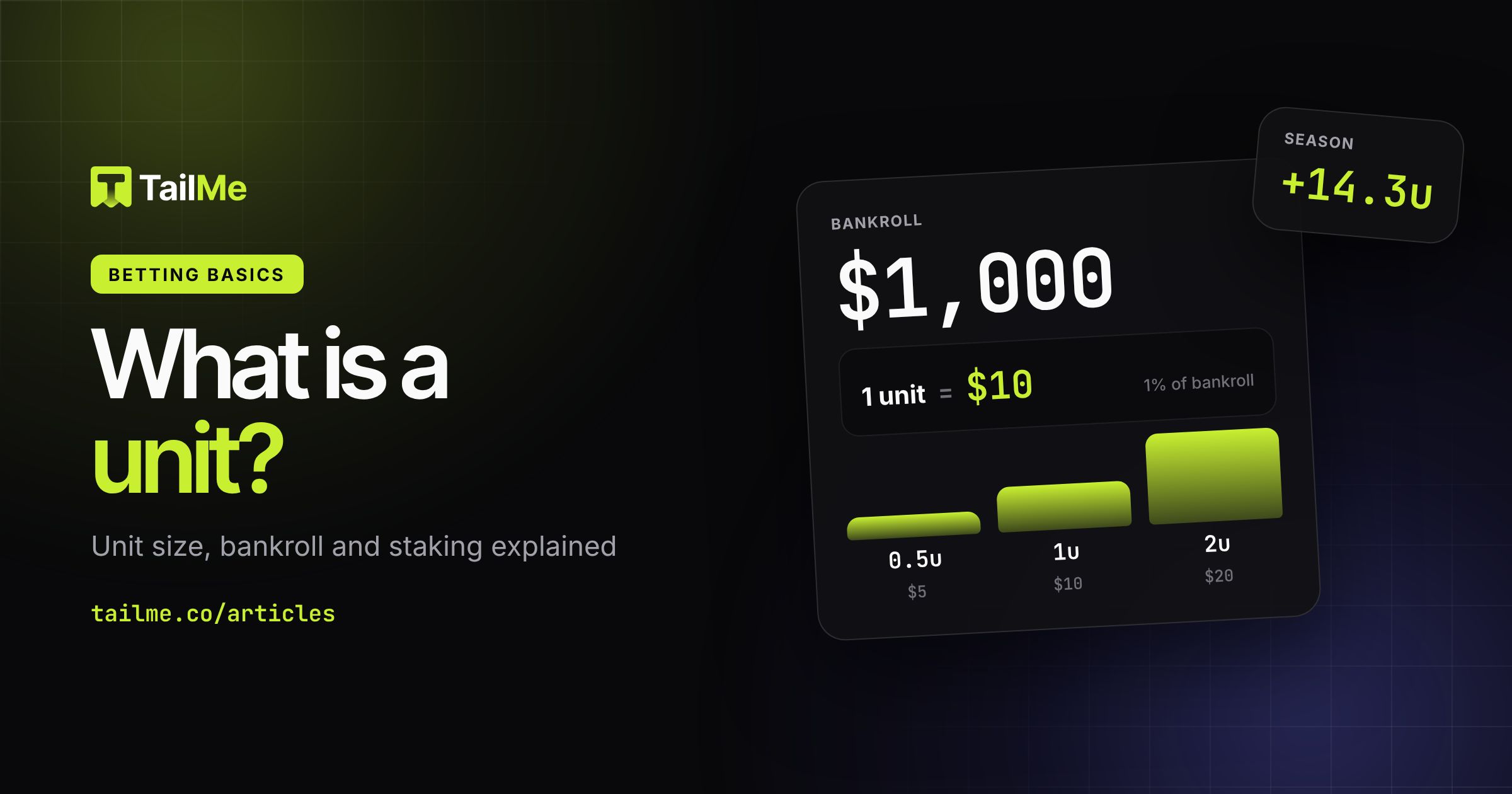
If you follow cappers on social media, you'll see "1u", "2u" and "+14.3u" everywhere. Units are how serious bettors talk about stakes and results without saying how much money they bet.
This guide explains what a unit is in sports betting, how to choose your unit size and why units are the fairest way to judge a capper's record.
What is a unit?
A unit is your standard stake: the amount you bet on a normal play. Instead of saying "I bet $50", you say "I bet 1 unit".
Most bettors set one unit at 1% to 2% of their bankroll. Your bankroll is the money you've set aside only for betting, separate from bills and savings.
| Bankroll | 1 unit at 1% | 1 unit at 2% |
|---|---|---|
| $500 | $5 | $10 |
| $1,000 | $10 | $20 |
| $5,000 | $50 | $100 |
| $20,000 | $200 | $400 |
Someone with $500 and someone with $20,000 can follow the same picks. A 1-unit bet is $5 for one and $200 for the other, but the size of the bet relative to their bankroll is the same.
Why bettors use units instead of dollars
Results are comparable. "+30 units" means the same thing whoever says it. "+$3,000" tells you nothing unless you know how much they bet.
It keeps stakes steady. Betting a set unit stops you chasing losses with bigger bets or getting carried away after a winning run.
It's private. Cappers can share their results honestly without telling the world how much they bet.
It protects your bankroll. At 1% per bet, even a 10-bet losing run costs about 10% of your bankroll. At 10% per bet, the same run nearly wipes you out.
How to choose your unit size
Start with your bankroll, then pick a percentage based on how much risk you're comfortable with. The unit size calculator does the maths for you.
- 1% (conservative): the most common choice. Good for most bettors and essential if you bet a lot of plays each day.
- 2% (moderate): fine if you bet fewer, more selective plays.
- 3% to 5% (aggressive): big swings. A normal losing run can take a large share of your bankroll.
Losing runs happen to every bettor, even good ones. A bettor who wins 55% of bets at -110 will still see runs of 6, 7 or 8 losses in a row over a season. Your unit size should let you survive that without changing how you bet.
Should you change your unit size?
Some bettors use a fixed unit for a whole season. Others recalculate monthly as their bankroll grows or shrinks.
Fixed units are simple and easy to track. Recalculating protects you during a downswing, because your stakes shrink as your bankroll shrinks, and lets you bet more as it grows.
Either works. What matters is choosing a rule in advance and sticking to it. Don't raise your unit after a hot week or "double up" to win back losses.
Betting more than 1 unit
Many cappers use a simple confidence scale:
| Stake | When it's used |
|---|---|
| 0.5u | Long shots, small edges, props with low limits |
| 1u | A standard play, most bets |
| 2u | A strong play the capper rates highly |
| 3u+ | Rare. Treat with caution |
Be wary of anyone who regularly posts 5-unit or 10-unit "locks". No bet is a lock, and big stakes on a few plays can hide a poor record overall. A capper who goes 1-0 on a 10-unit play and 0-5 on 1-unit plays shows +4.1 units, even though they lost most of their bets.
Units won vs units risked
There are two ways to report a stake, and it's worth knowing which one a capper uses.
- To risk: "1u" means you bet 1 unit. On a -150 favourite, a 1u bet wins 0.67u.
- To win: "1u" means the bet is sized to win 1 unit. On a -150 favourite, you'd risk 1.5u to win 1u.
Most cappers use "to risk" for plus-money bets and "to win" for heavy favourites, so a -200 favourite doesn't win only half a unit. As long as it's consistent and clearly stated, either is fine.
How to work out units won
For a bet at American odds:
- Positive odds: units won = units risked × (odds ÷ 100). 1u at +150 wins 1.5u.
- Negative odds: units won = units risked × (100 ÷ odds). 1u at -110 wins 0.91u.
A loss is simply minus the units risked. A push is zero.
Add up every bet and you get your total units, the number cappers show in their bio. Divide your total units by the total units you risked to get your ROI.
Units and your record
Units only mean something if every bet is counted. A record of +40 units is impressive if it's every pick from the season, and meaningless if the losses were quietly left out.
When you judge a capper, look for:
- Units and ROI together. +40 units from 2,000 bets is a 2% ROI. +40 units from 200 bets is 20%. Very different records.
- Number of bets. A hot month proves little. Hundreds of bets tell you much more.
- Consistent unit sizes. Big stakes on a handful of bets can hide a losing record.
Our guide on how to track your betting record shows how to keep an honest record with units, ROI and win rate.
For cappers
Posting in units is the standard for a reason. It lets anyone follow along at their own stake, and it makes your record easy to understand.
On TailMe, each pick shows its stake in units, and your record adds up your units and ROI for you. Followers can see your results at a glance, labelled clearly as self-reported.
The short version
A unit is your standard stake, usually 1% to 2% of your bankroll. Units let bettors compare results fairly, keep stakes steady and survive losing runs. Choose your unit size in advance, keep it consistent and count every bet.
Only bet what you can afford to lose. If betting stops being fun, free and confidential support is available.