Point Spread Betting Explained: How the Spread Works
Point spread betting explained in plain English: how the spread works, what -110 means, pushes, key numbers, buying points and the win rate you need.
Point spread betting is the most common way to bet football and basketball in the US. Instead of picking who wins, you pick who covers a margin set by the sportsbook. This guide explains how the spread works, what the numbers mean, and how to judge whether a spread bet is worth making.
What is point spread betting?
A point spread is a handicap that evens out a game between two teams of different strength. The sportsbook gives the stronger team a points deficit and the weaker team a points head start. You then bet on which side does better once that handicap is applied.
Here is a typical NFL line, using made-up teams:
| Team | Spread | Price |
|---|---|---|
| Rivertown | -6.5 | -110 |
| Lakeside | +6.5 | -110 |
Rivertown is the favorite. The minus sign means they give up 6.5 points. Lakeside is the underdog. The plus sign means they get 6.5 points.
How does the point spread work?
The result of a spread bet depends on the final margin, not just the winner.
- Bet on Rivertown -6.5: they must win by 7 or more. A 24-17 win covers. A 24-20 win does not.
- Bet on Lakeside +6.5: they cover if they win outright or lose by 6 or fewer. A 20-17 loss still wins your bet.
A simple way to check any spread bet: add the spread to your team's final score. If that number is higher than the other team's score, you win. For Lakeside +6.5 in a 20-17 loss, 17 + 6.5 = 23.5, which beats 20.
What does -110 mean on a spread?
The number next to the spread is the price. At -110, you risk $110 to win $100. Your stake comes back too, so a winning $110 bet returns $210 in total.
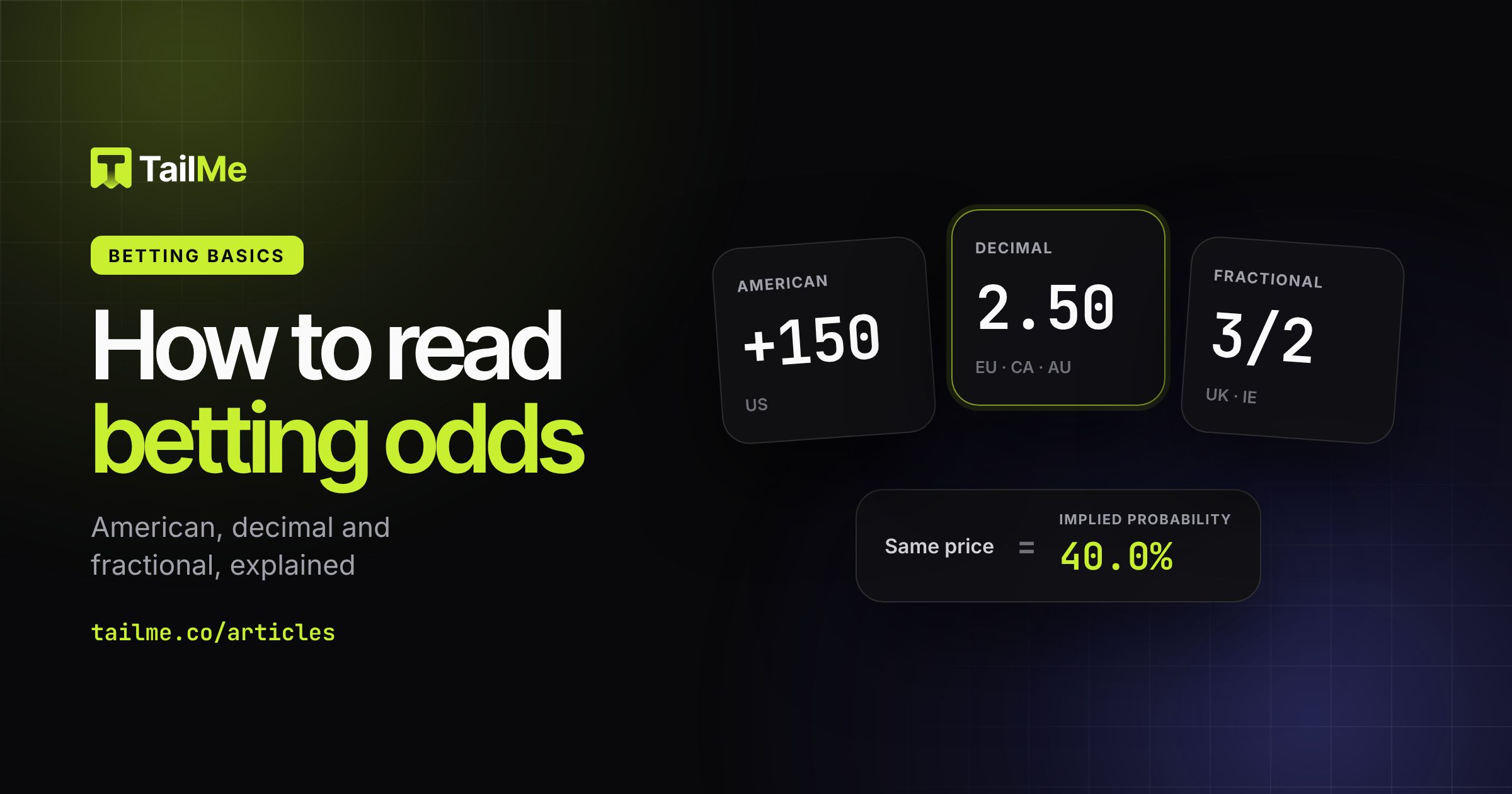
Smaller stakes work the same way. A $50 bet at -110 wins $45.45 and returns $95.45. In decimal odds, -110 is about 1.909. If American odds are new to you, our guide on how to read betting odds covers all three formats.
Why both sides cost -110
If both sides are priced at -110, the book is not offering a fair coin flip. The implied probability of -110 is 52.38%. Add both sides and you get 104.76%. The extra 4.76% is the vig, the sportsbook's built-in margin.
The break-even win rate
That margin sets the bar you need to clear. At -110 you need to win 52.38% of your spread bets just to break even. Some examples at 1 unit risked per bet:
| Record | Profit (units) |
|---|---|
| 52-48 | -0.73 |
| 53-47 | +1.18 |
| 55-45 | +5.00 |
Going 52-48 feels like winning, but it still loses money. This is why cappers who post a spread record without units and ROI only tell half the story.
Half points, whole numbers and pushes
Spreads come in two forms.
Half-point spreads
A line like -6.5 cannot land exactly, because games end in whole numbers. Someone always wins and someone always loses. That extra half point is called the hook.
Whole-number spreads and pushes
A line like -7 can land exactly. If Rivertown is -7 and wins by exactly 7, the bet is a push. Your stake is returned and you neither win nor lose. In a parlay, how a pushed leg is settled depends on the sportsbook's house rules, so check them before you build one. Our guide to how parlay odds work explains the basics.
Key numbers in NFL spread betting
Not every point on a football spread is worth the same. Because of how scoring works (field goals worth 3, touchdowns plus extra points worth 7), some final margins come up far more often than others. Three and 7 are the most common, which is why they are called key numbers.
That matters for which number you bet:
- Getting +3.5 instead of +2.5 as an underdog moves you across the most common margin in the sport.
- Laying -2.5 instead of -3.5 as a favorite does the same in the other direction.
- Moving from -9.5 to -10.5 rarely matters as much, because 10 is a less common margin.
Basketball has no key numbers in the same sense. NBA scoring is more spread out, so each half point on a basketball spread tends to matter more evenly.
Buying points and alternate spreads
Most sportsbooks let you move the spread in your favor for a worse price. This is called buying points, or taking an alternate spread.
Say Rivertown is -3 at -110 and you buy a half point to -2.5 at -125. You now risk $125 to win $100, and your break-even rate rises from 52.38% to 55.56%. That trade can make sense off a key number like 3 and rarely makes sense elsewhere. Always compare the higher break-even rate against how much the extra half point is likely to help.
Point spread vs moneyline
A spread bet asks "by how much?" A moneyline bet asks only "who wins?"
| Spread | Moneyline | |
|---|---|---|
| What you bet on | Winning margin | Outright winner |
| Typical price | Close to -110 both sides | Big gap between sides |
| Favorite example | -6.5 at -110 | -280 |
| Underdog example | +6.5 at -110 | +230 |
On the moneyline, a -280 favorite needs to win about 73.68% of the time to break even, and a +230 underdog about 30.30%. The spread turns a lopsided matchup into something close to a 50/50 proposition, which is why it is so popular for NFL and NBA games.
How cappers should post and track spread picks
If you share picks, small details make your record trustworthy:
- Post the exact number and price. "Lakeside +6.5 (-110)" is clear. "Lakeside" is not.
- Post before kickoff, with a timestamp, so followers can tail at the same number.
- Grade pushes as pushes, not wins or losses.
- Track units, not just wins and losses. A 55-45 record at -110 is +5.00 units. Our guide on how to track your betting record walks through the math.
- Compare your number to the close. If you regularly beat the final line, that is a good sign. See closing line value for more.
A TailMe page lets you show spread picks as bet slips next to your self-reported units and ROI, so followers see the number, the price and the record in one place.
Common point spread mistakes
- Ignoring the price. -6.5 at -110 and -6.5 at -120 are different bets. The second needs a 54.55% win rate to break even.
- Not shopping lines. Books often differ by a half point or a few cents. Over a season, that adds up.
- Chasing a bad beat. A late backdoor cover is part of spread betting. Stick to your normal stake size.
- Betting every game. You do not need an opinion on every game on the slate. Fewer, better bets beat volume.
- Treating 52% as a winning record. At -110 it is not. Use the break-even calculator or the implied probability calculator to check.
The short version
- A point spread handicaps the favorite (minus) and gives the underdog a head start (plus).
- Add the spread to your team's score. If it beats the other team's score, your bet wins.
- At the standard -110 price you need to win 52.38% of the time to break even.
- Whole-number spreads can push, which refunds your stake. Half-point spreads cannot.
- In the NFL, 3 and 7 are key numbers, so half points around them are worth more.
- Buying points raises your break-even rate, so only do it when the move is worth the cost.
Only bet what you can afford to lose. If betting stops being fun, free and confidential support is available.